


KipKip the Skyrat
- Jul 31, 2018
- 4 min read

Hey guys!
Before I get into this post, I just want to make a couple of things clear...
KipKip is a laughing dove, and although they are not classified as a domesticated breed, I am unable to let her free. Trust me when I say that we have given this a lot of thought, especially being pro-animal and wanting the best for them.
Unfortunately in Kippie's case, I've had her since she was a few days old and she has been 100% hand-reared... This means that she is completely dependent on us providing her with food and she is too tame to be able to survive in the wild.
Now that that's out of the way, let me tell you the story of KipKip the Skyrat.

A couple of months ago I was contacted by a colleague of mine (a fellow waitress, as I was at the time) and she asked about keeping a baby dove alive.
This is Kippie on the day that she was rescued:
A tiny bundle of feathers.
She was ice cold, wasn't making any noise or moving around, so my first priority was getting her to warm up and keep her temperature stable.
Chicks run at, and require, a higher temperature to survive. As they grow, the temperature they need to stay warm drops. This being said, it's also really important to ensure that they don't overheat, as chicks have a higher mortality rate at higher temperatures than lower temperatures. The reason for this is that they are able to slightly warm themselves through shivering, but are unable to efficiently regulate temperature if they get too hot.
For the most part I kept Kippie closer to me for body-heat, and at night when I obviously couldn't have her in the bed for fear of having a squashed chick in the morning, she slept in a cardboard box with her own water-bottle and blankie. We kept a close eye on the heat of the box and changed the water-bottle first thing in the morning.
For the first few days KipKip was fed a mixture of plain ProNuturo, a high protein cereal that's pretty popular here in South Africa, and warm water. As it's very dangerous to try feeding water to a baby dove for fear of aspiration (inhaling water), so any moisture they get has to be through the food they get from Mommy Bird, or in more technical terms: crop milk.
In KipKip's case, this just meant that her ProNutro was really watery.
After a couple of days, her cereal was upgraded to Avi Plus Handrearing "Phase 1". This is a very fine mixture of ingredients that looks very similar to a porridge or a meal, and is suitable for all species of birds.

Initially, since I feeding her with a syringe, the feeding periods were spaced two hours apart, about 2-3 mL of mixture at a time.
And I was PEDANTIC about sticking to the feeding times. Unlike with handrearing kittens or puppies, chicks stop eating once the sun goes down. So at least I wasn't waking up in the middle of the night to feed her.
Every morning was still mad rush to get to the box to make sure that our new charge had made it through the night.
Over the weeks the feedings were spaced about 3 hours apart, but at a higher quantity of up to 5 mL of feed at a time... By this point KipKip was a breeze to feed, eager to eat every time, even complaining in the hours in between and flapping her wings like crazy. I had become a super proud Mommy Bird!
The trick with feeding baby doves is to cup your hand over them, palm facing down, and to then fit their beak in between your index finger and middle finger of the hand that will not be feeding them. Usually this is enough to stimulate them to open their beaks in anticipation of food, but if not, you may need to very gently coax their beaks open with the tip of the syringe.

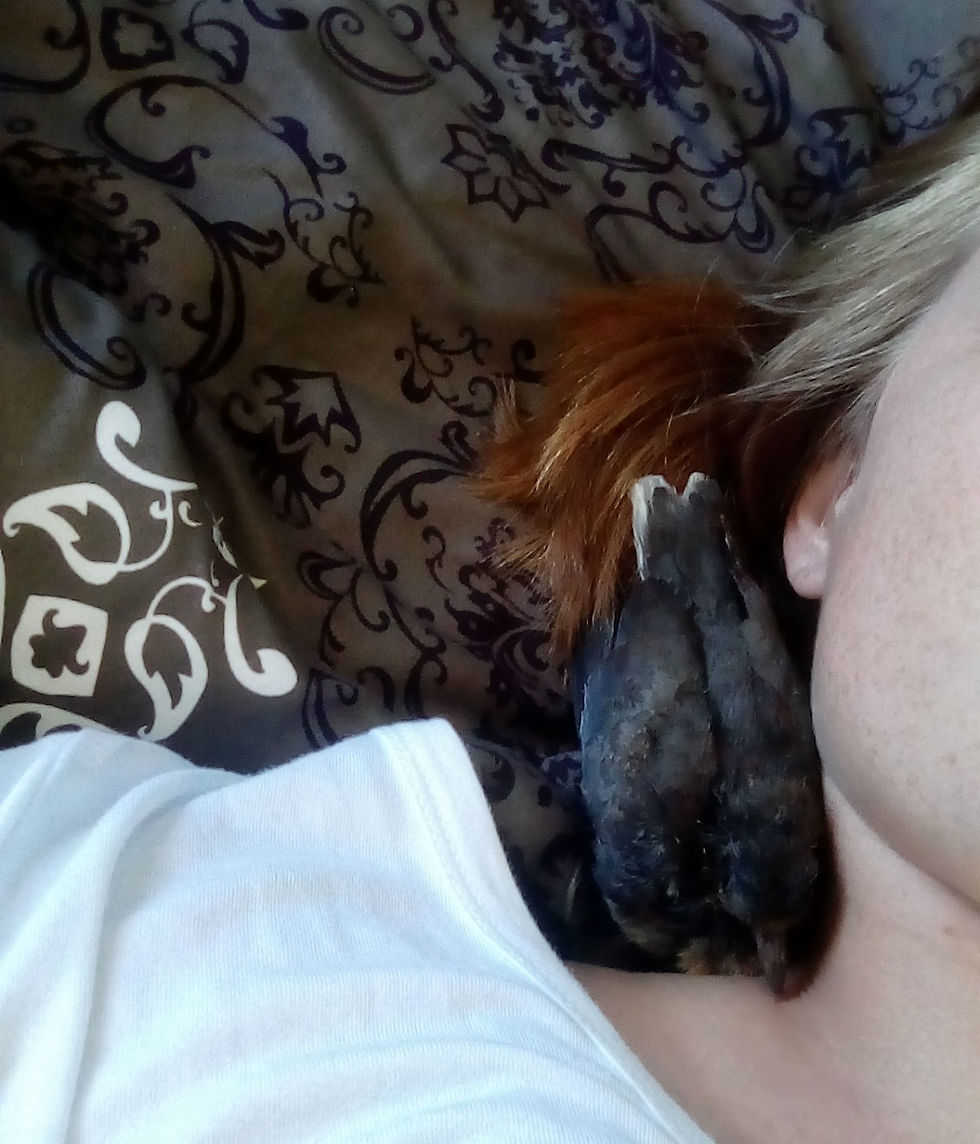

As much as I love this bird, there is no way I could delude myself into thinking that she was a pretty bird during the growth process... she was a very unattractive adolescent bird. But man she was (and is) affectionate.

After she had been with us for about two weeks, the flapping started. At first all she could manage was just to get off the floor and onto the bed. After a couple more flights she was confident enough to fly across the room.
Her favourite way to greet us now is to fly at our faces and sit on our heads.
New party trick.
The progression from hopping to flying meant an upgrade from her box to a small cage. At this point she still had to be fed every few hours and I was working as an Au Pair and assistant nursery school teacher, which meant that she was going on frequent trips with me.
After a few more weeks of this, even though she still demanded to be fed by hand, she had deigned to eat some seeds. The mix consisted of baby chick (chicken) feed and smaller seeds meant for finches and canaries.
The move from being fed by hand to voluntarily eating seeds meant that KipKip could now stay at home and chill whilst I was out and about.
She now has a much bigger cage in our room to sleep in and during the day we leave the door open for her to fly about as much as she wants.
We are also in the process of designing and aviary for her.

Like I mentioned at the start of this post, KipKip is too used to humans for us to let her go. Check out the pic below of her approaching our (then) new kitten. It should be mentioned that she was going for the kitten's tail as well.
Absolutely no fear.
I also want to clarify that not every baby dove found on the ground has fallen out of a nest or been abandoned, but in case someone comes across a chick that needs to be handreared, along with the many Google tutorials, I hope this helps.
Cheers,
Tasha
Comments